Ethical Birding & Nature Photography
Distance | patience | quiet | respect
Respecting our birds and their habitats is essential for responsible birding.
At Headlands, thousands of migrating birds rely on our shoreline, dunes, woods, and wetlands as a critical place to rest and refuel. Ethical birding helps ensure every visitor can enjoy these remarkable encounters while protecting the birds and habitats that make this festival possible.
Bird welfare always comes first. This page helps birders, photographers, and videographers enjoy meaningful encounters while protecting the birds and habitats we all care about.
Our Guiding Principle
In every situation, the welfare of the bird and its habitat comes before observation, photography, video, or the chance to share a rare sighting. This follows the widely accepted ABA Code of Birding Ethics, which emphasizes minimizing stress, protecting habitat, and respecting other people who share the outdoors.
When photographing birds, please follow the guidance of Audubon’s Guide to Ethical Bird Photography and Videography.
Best Birding Practices
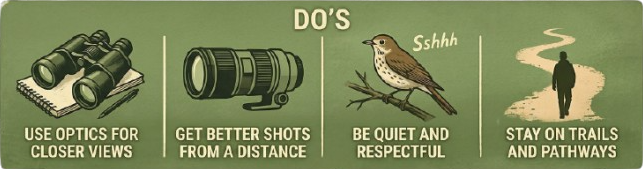
Help birds stay safe by giving them space, staying on trails, and letting natural behavior unfold.
What to Avoid
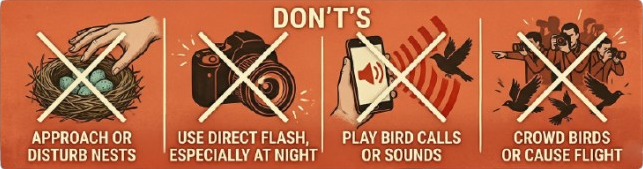
Avoid disturbing nests, flushing birds, using playback, or entering protected habitat.
Birding Ethics
Keep a respectful distance
- If a bird changes its behavior because of your presence, you are too close.
- Use binoculars, spotting scopes, long lenses, or cropping instead of approaching.
- Avoid blocking feeding, hunting, or flight paths.
- Give extra space to roosting owls, shorebirds, and waterfowl.
Stay on established paths
- Remain on trails, boardwalks, dune paths, and designated overlooks.
- Avoid trampling vegetation, beach grasses, or sensitive shoreline habitat.
- Never enter restricted nesting or restoration areas.
Respect nesting birds
- Never approach active nests for a better view, photo, or video.
- Avoid lingering near cavity nests, colonies, lek sites, or fledgling areas.
- If adults begin alarm calling, dive-bombing, or carrying food but not approaching, back away immediately.
- Do not share exact nest locations publicly.
Avoid playback and baiting
- Do not use song playback, pishing apps, or call recordings to lure birds, especially during migration and nesting season.
- Never bait owls, hawks, or other birds with food to create photo opportunities.
- Artificial attraction methods can disrupt feeding, territorial behavior, and breeding success.
Photography and Videography Ethics
Prioritize natural behavior
The best wildlife images show birds behaving naturally. If your presence changes posture, movement, vocalization, or attention, the moment is no longer ethical.
Use gear, not proximity
- Choose longer focal lengths instead of moving closer.
- Use blinds, cars, or natural cover where appropriate.
- Let the bird come to you.
- Patience is better than pursuit.
No flushing for flight shots
Do not intentionally startle birds into flight for dramatic images or video. Repeated flushing wastes critical energy, especially for migrants, wintering birds, and hunting raptors.
Use artificial light sparingly
Avoid flash, spotlights, or bright continuous lights, especially at night or around owls, nightjars, rails, and nesting birds. Artificial light can disorient birds and alter behavior.
Sound recording and video audio
- Do not repeatedly provoke vocal responses.
- Keep microphones and boom poles outside sensitive areas.
- Never alter habitat to “clean up” a shot or soundscape.
Ethics is also about creating a welcoming, conservation-minded community. No image is worth harming a bird.
Rare Birds & Social Sharing
The excitement of sharing a rarity should never put the bird at risk.
A good rule: share responsibly, not instantly.
Before posting…
- Consider whether crowds could disturb the bird.
- Avoid sharing exact locations for owls, nesting birds, rails, roosts, or endangered species.
- Delay posting sensitive sightings until the bird has moved on.
- Follow hotspot or preserve-specific rules.
Be a Good Community Member
- Give others space at viewing areas.
- Keep voices low.
- Take turns at scopes and photo blinds.
- Help beginners learn ethical practices.
- Kindly model good behavior rather than confrontational criticism.